
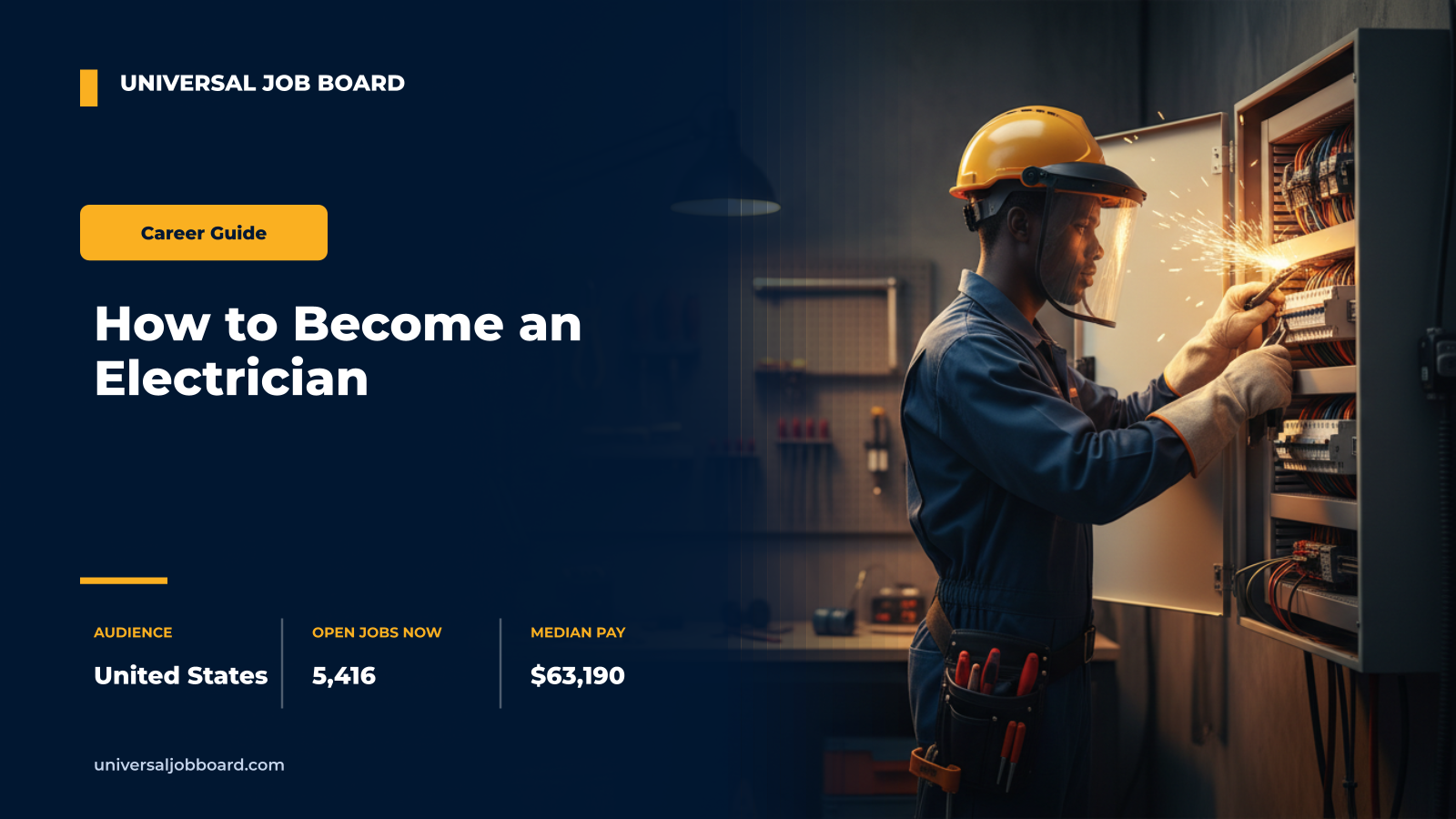

Learning how to become an electrician means choosing between a paid apprenticeship, a trade-school route and a state licence. Each step has its own cost and timeline. This guide covers what electricians earn according to official wage data, the steps to take this month, realistic cost and time ranges, and where employers are hiring right now. It also covers the downsides, so you can decide whether the years of training are worth it. Rules vary by state, so use the official bodies named below to confirm the details for where you live.
Data updated October 2026 using official wage statistics and live job listings.
Key facts
- Median annual pay: $63,190 (BLS OEWS, May 2025)
- Pay range (10th to 90th percentile): $42,640 to $108,510
- Number employed in the US: 757,220
- Live openings matching “electrician” right now: 5,416 (Adzuna, October 2026)
- Top hiring employers in current listings: U.S. Navy, EMCOR Group, West Fraser, Faith Technologies, Oracle
Table of Contents
How to become an electrician: the path at a glance
Most electricians in the US follow the same ladder: apprentice, then journeyman, then (optionally) master electrician. You start as a paid trainee working under a licensed electrician. You also take classroom instruction in electrical theory, safety and the National Electrical Code.
You do not need a college degree. You generally need to be at least 18, hold a high school diploma or GED, and be able to pass a basic maths and reading assessment. Some apprenticeship programs also ask for a driver’s licence and a drug screen.
The usual timeline is a four- to five-year apprenticeship, often totalling about 8,000 hours of on-the-job work plus a few hundred hours of classroom study. After that, most states require a journeyman licensing exam. The exact hours, exam and licence names are set by each state or locality, so confirm them with your state licensing board before you commit.
What electricians earn
According to the Bureau of Labor Statistics (BLS OEWS, May 2025), 757,220 people work as electricians (SOC 47-2111) in the US. The median annual wage is $63,190 and the mean is $71,490. Because the mean is higher than the median, a group of high earners pulls the average up.
The spread matters more than the average. The 10th percentile earns $42,640, which is typical of newer workers and lower-paying regions. The 90th percentile earns $108,510. Location is a big driver: the table below shows the highest state medians in the BLS data.
| Measure / state | Annual wage |
|---|---|
| National 10th percentile | $42,640 |
| National median | $63,190 |
| National mean | $71,490 |
| National 90th percentile | $108,510 |
| Illinois (median) | $99,560 |
| Washington (median) | $95,220 |
| Massachusetts (median) | $79,420 |
| New York (median) | $78,750 |
| New Jersey (median) | $77,250 |
| Michigan (median) | $76,270 |
| California (median) | $76,160 |
So, do electricians make $100,000 a year? Some do, but it is not the typical result. The national 90th percentile is $108,510, and Illinois has a state median of $99,560. Reaching six figures usually takes experience, a specialty or a master licence, and often a high-paying region or overtime. Other states in the BLS data sit lower, for example Texas at $58,570, Florida at $57,250 and North Carolina at $56,800. Those figures are medians, and living costs differ as well.
Advertised pay in current listings is noisier than BLS data, and Adzuna sometimes estimates it. Among listings that show a salary, the largest group (2,734) sits in the $60,000 bracket, followed by 2,239 in the $80,000 bracket. Use that as a rough sense of the market, not as a promise of what you will earn.
Step-by-step: what to do this month
You can start moving on this path within weeks. Here is a practical order of operations.
- Check your state’s rules first. Search for your state’s electrical licensing board (often within a Department of Labor, Department of Commerce or a professional regulation agency). Note the hours required for each licence level and whether the licence is state-level or issued by cities and counties.
- Confirm the basics. Make sure you have a high school diploma or GED, ID, and, if the programs near you ask for it, a driver’s licence. If your algebra is rusty, brush up now, because many apprenticeship aptitude tests cover algebra and reading comprehension.
- Find apprenticeship programs. Look at the US Department of Labor’s apprenticeship resources, local chapters of the IBEW and NECA (joint union-employer programs), and the Independent Electrical Contractors (IEC) and Associated Builders and Contractors (ABC) chapters, which run non-union programs. Applications often open only at certain times of year, so check deadlines.
- Apply to several at once. Competitive programs can have more applicants than places. Apply to union, non-union and employer-run programs together, and keep a note of test dates and interview windows.
- Consider a pre-apprenticeship or trade-school course. A community college or trade school certificate can strengthen your application and may count toward classroom hours in some states. It is not required in most places, so ask the licensing board how any credit is treated before paying tuition.
- Apply for entry-level work as a backup. If you do not get into a program right away, an electrician’s helper or contractor assistant job can build experience. Check whether your state counts that time toward licensing hours, because some states do not.
- Register as an apprentice and log your hours. Many states require you to register with the licensing board and keep a precise record of hours worked and the type of work done. Poor records are a common reason for delays at exam time.
- Plan for the journeyman exam. Begin studying the National Electrical Code well before your final year, because exams are often open-book but time-pressured and depend on knowing where to find answers quickly.
Licensing, exams and realistic costs
This is where the path varies most from state to state, so treat the figures here as typical ranges and verify them locally. If you are asking how long it takes to become an electrician in Virginia, Delaware or anywhere else, the answer comes from that state’s board. In Virginia, check the Department of Professional and Occupational Regulation; in Delaware, check the Division of Professional Regulation. Many states broadly follow the four- to five-year pattern.
Typical timeline. A full apprenticeship usually takes about four to five years. Trade-school programs are often shorter, from several months to two years, but they generally lead into an apprenticeship rather than replacing it.
Typical costs. Formal apprenticeships, especially union and joint programs, often charge little or nothing for tuition because you earn while you learn. You may still pay for textbooks, tools, work boots and exam fees. Trade-school tuition can run from a few thousand dollars to well beyond that depending on the school and length of the program. Licence exam and application fees differ by state, so check the official site for current fees.
Licence levels. Common levels are apprentice (or registered trainee), journeyman and master. A master licence typically requires additional years as a journeyman and another exam, and it is often what lets you pull permits and run your own contracting business. Some states also require a separate contractor licence, a bond or insurance.
Specialties. Residential, commercial, industrial and line work are common tracks. Instrumentation, medium-voltage and controls work often asks for extra training but can offer more varied work. Which specialty you choose affects both your day-to-day work and your earning ceiling.
Moving between states. Some states have reciprocity agreements, and some do not. If you plan to relocate after you qualify, check whether your licence will transfer before you assume it will.
Where the jobs are right now
Adzuna’s live listings (October 2026) show 5,416 current vacancies with “electrician” in the title. The top employers by open roles in the data are:
- U.S. Navy: 22,177 open roles (this count may cover many job types beyond electricians)
- EMCOR Group: 336 open roles
- West Fraser: 331 open roles
- Faith Technologies: 301 open roles
- Oracle: 275 open roles
The mix is useful. Contractors such as EMCOR Group and Faith Technologies hire for construction and building systems work. Industrial and manufacturing employers hire in-house maintenance electricians, which often means steadier hours and a single site. The Navy and other large organisations hire across many trades.
Here is a sample of openings from the current listings:
Hiring now
- Instrumentation/Medium Voltage Electrician Utilities — Lilly, West Indianapolis, Marion County
- Residential Service Electrician — Brilin Electric, Tega Cay, York County
- Journeyman Electrician – Full Time — Cargill, Ionia, Ionia County
- Full-time Licensed Electricians — Cargill, Lansing, Ingham County
- Industrial Electrician — Aerotek, Walton Hills, Cuyahoga County
Notice that several of these ask for a journeyman or licensed electrician. Entry-level apprenticeship openings are often advertised through union halls, training centres and contractor associations rather than general job boards, so use both routes.
Is this career right for you?
Is becoming an electrician worth it in 2026? For many people it is a solid route to a skilled trade without college debt, but it is demanding. Here is an honest balance.
Pros
- You earn while you train, rather than paying for years of tuition first.
- Pay can rise meaningfully with licensing and specialisation: the national median is $63,190, while the 90th percentile is $108,510.
- Skills transfer across residential, commercial, industrial and utility work, and you can choose a path that fits your lifestyle.
- Master electricians can go into business for themselves, subject to state rules.
Cons
- Starting pay is lower: the 10th percentile is $42,640, and apprentices typically earn a percentage of journeyman wages in their early years.
- The work is physical, with ladders, crawl spaces, heat, cold and tight spaces.
- Electrical work carries real safety risks, so strict procedures and attention to detail are essential.
- Apprenticeship places can be competitive, and licensing rules vary, which complicates moving between states.
- Pay varies a lot by location. The Illinois median is $99,560, while the North Carolina median is $56,800.
If you like problem-solving, working with your hands and seeing a finished result, the trade can suit you. If you dislike physical work or irregular site conditions, test it first with a short course or a conversation with working electricians.
Frequently Asked Questions
How long does it take to become a qualified electrician?
Most people need about four to five years to complete an apprenticeship and reach journeyman level, which often involves around 8,000 hours of paid on-the-job training plus classroom study. Your state licensing board sets the exact requirement, so check it before you plan your timeline.
How long does it take to become an electrician in Virginia?
Virginia follows the broad pattern of years of supervised work and related instruction before a journeyman licence, but the exact hours and exam details are set by the state. Check the Virginia Department of Professional and Occupational Regulation for the current requirements and fees.
Do electricians make $100,000 a year?
Some do, but it is not typical. BLS data (May 2025) shows a national median of $63,190 and a 90th percentile of $108,510. Illinois has a state median of $99,560. Reaching six figures usually requires experience, a licence upgrade, a specialty or a high-paying region.
Can I become an electrician with no experience or no degree?
Yes. Apprenticeships are designed for beginners, and you generally need a high school diploma or GED rather than a degree. A pre-apprenticeship or short trade course can help your application, and adults changing careers are often accepted, though programs may have their own age and aptitude requirements.
Is electrician worth it in 2026?
It can be, if you accept the physical demands and the years of training. There are 5,416 live listings with “electrician” in the title (Adzuna, October 2026), and you earn while you learn. Pay depends heavily on your state and specialty, so compare local wages before you commit. Nothing is guaranteed, and results vary by region and employer.
Sources
- U.S. Bureau of Labor Statistics, Occupational Employment and Wage Statistics (OEWS), May 2025, SOC 47-2111: https://www.bls.gov/oes/
- Adzuna live job listings (US), retrieved October 2026
- Google search results for “how to become an electrician” (US), October 2026, used for common reader questions
- Official bodies to check for current rules and fees: your state electrical licensing board, the Virginia Department of Professional and Occupational Regulation, the Delaware Division of Professional Regulation, the US Department of Labor (apprenticeship resources), IBEW and NECA, IEC and ABC
The trade rewards people who start, so pick one apprenticeship program and one licensing board to contact this week.
