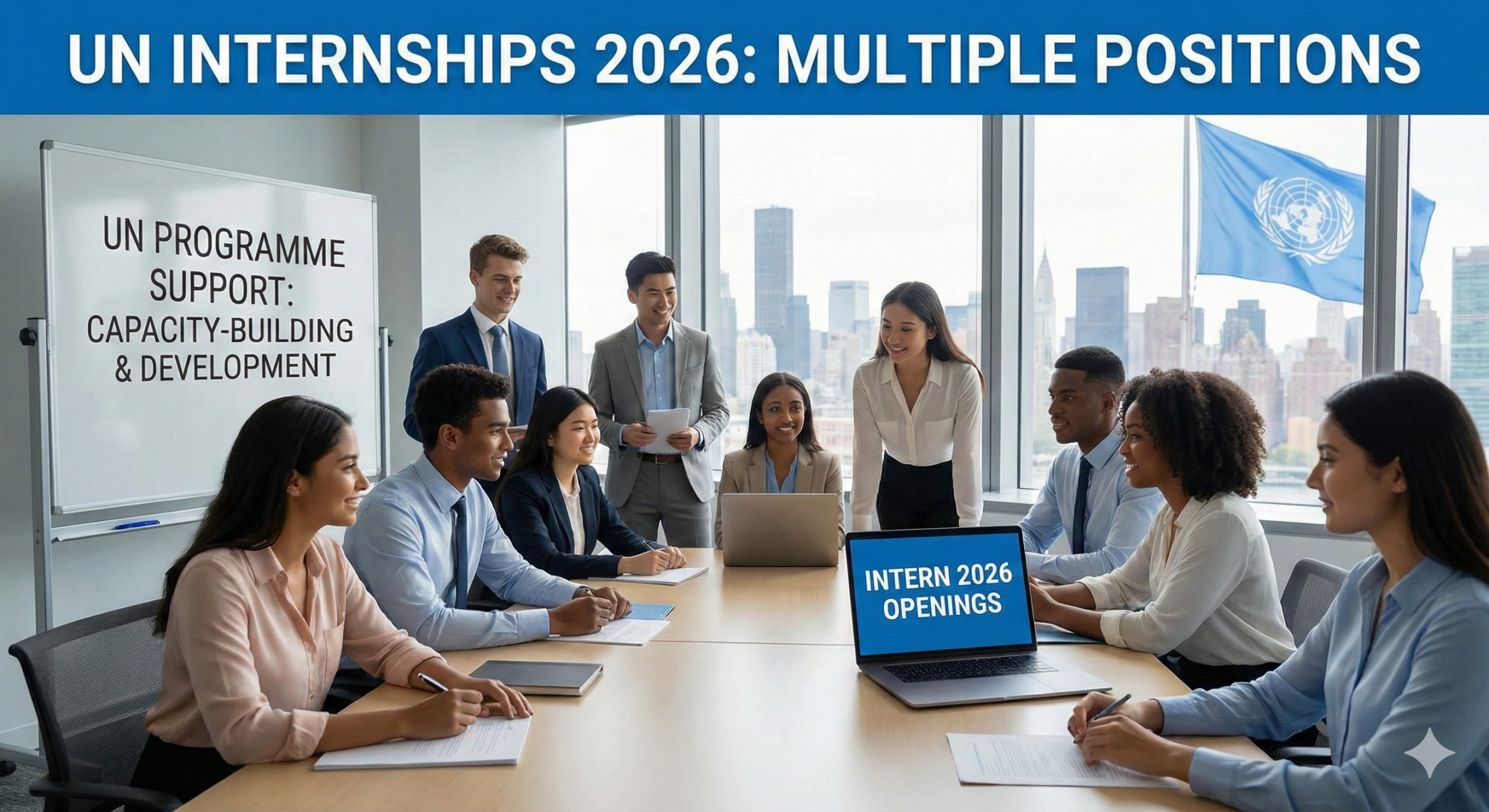

Breaking into the United Nations system is often perceived as a monumental challenge, a bureaucratic labyrinth where qualified candidates struggle to find a foothold. The Multiple positions at UN Programme Support: Capacity-Building and Development Intern 2026 role represents a strategic entry point into this world, specifically targeting the machinery that keeps development goals moving forward. Unlike high-level diplomatic postings, this internship digs into the operational realities of capacity-building, a critical function that empowers local institutions to manage their own development trajectories. For a young professional eyeing a career in international relations or sustainable development, this isn’t just a temporary job; it is a masterclass in the administrative and technical scaffolding required to execute UN mandates on the ground.
Working within the Programme Support unit means you are the connective tissue between policy design and implementation. The United Nations Development Programme (UNDP) and similar agencies face the constant challenge of translating broad Sustainable Development Goals (SDGs) into actionable, local programs. This role places you directly in that translation process, requiring a blend of analytical rigor and interpersonal agility. If you are looking to transition from academic theory to practical application, this internship offers a front-row seat to how global development agendas are operationalized.
Also check United Nations Job: Finance Assistant (WFP N’Djamena) – 2026
Table of Contents
Background & Job Description
The United Nations Secretariat is the primary engine room of the organization, handling everything from peacekeeping logistics to development facilitation. The specific listing for Multiple positions at UN Programme Support: Capacity-Building and Development Intern 2026 falls under the broader umbrella of UN field operations and programme management. Capacity-building is a technical term for a vital process: it involves strengthening the ability of national institutions, civil society, and local governments to absorb resources, manage funds, and implement projects autonomously. Without effective capacity-building, development aid often fails to stick.
In the context of the 2026 cycle, these roles are likely situated in diverse geographical contexts, potentially spanning regions in Africa, Asia, or Latin America where the UN has active country teams. The intern will support the Programme Support unit, which handles the administrative backbone of project cycles. This includes monitoring deliverables, managing data for reporting, and assisting in the organization of workshops designed to train local stakeholders. You will be working under the supervision of a National Officer or Programme Manager, contributing to the drafting of progress reports that feed into larger donor updates and strategic reviews.
Understanding the operational footprint is crucial. The United Nations does not simply “deliver” aid; it coordinates complex ecosystems involving governments, NGOs, and private sector partners. As an intern in this stream, you are learning the mechanics of multilateral cooperation. You will see how international policy frameworks, such as the Paris Agreement or the 2030 Agenda for Sustainable Development, are broken down into measurable indicators and tracked via sophisticated database tools. This role is about ensuring that development assistance is not just a transaction, but a transformation.
The Insider’s Perspective
Stepping into a capacity-building internship requires a mindset shift from that of a student to that of a practitioner. It is a role that demands high emotional intelligence alongside technical proficiency. You will often be working with sensitive data regarding government performance or community vulnerabilities, requiring absolute discretion and ethical integrity. The pace can be demanding, particularly when field offices are rushing to meet quarterly reporting deadlines or responding to emerging crises.
“Capacity-building roles are the unsung heroes of the UN system. They are rarely glamorous, often involving meticulous data entry and cross-departmental coordination, but they are where the actual work of sustainable development happens. A successful intern here is one who treats administrative tasks with the same strategic importance as high-level policy briefs.”
From an insider’s view, the value of this internship lies in its exposure to the full project lifecycle. You aren’t just observing; you are actively maintaining the Logical Framework (LogFrame), a project management tool used by virtually every international development agency. You will learn to navigate UNDP’s Atlas system or similar ERP software, which is a skill highly transferable to other international organizations. The social capital you build—connecting with program officers, policy analysts, and external partners—is often more valuable than the stipend itself. It is a rigorous vetting ground for future fixed-term appointments.
Key Responsibilities
The Multiple positions at UN Programme Support: Capacity-Building and Development Intern 2026 role typically involves a diverse set of tasks that bridge administrative support and substantive analysis. While the specific duties will vary based on the duty station, core responsibilities generally include:
- Monitoring and Evaluation (M&E) Support: Assisting in the collection of data to track project performance indicators. This involves coordinating with field officers to ensure that quantitative and qualitative data are accurate, timely, and aligned with the approved work plan. You may be required to use tools like Excel, KOBO Toolbox, or specialized UN M&E software.
- Drafting and Communication: Preparing background documents, briefing notes, and minutes for meetings. The ability to synthesize complex information into concise, readable formats is essential. You will draft sections of regular progress reports for donors, ensuring compliance with specific formatting and language requirements.
- Stakeholder Coordination: Providing logistical support for capacity-building workshops and training sessions. This includes coordinating with vendors, managing participant lists, and assisting in the preparation of training materials. Strong organizational skills are paramount here.
- Knowledge Management: Maintaining and organizing the programme’s digital filing systems. You will be responsible for ensuring that all project documents—from inception reports to final evaluations—are properly archived and easily accessible to the team.
- Research & Analysis: Conducting literature reviews on specific development topics relevant to the country context. For example, if the program focuses on renewable energy, you might research local energy regulations or comparative case studies from neighboring regions.
Qualifications
Required Qualifications
To be competitive for the Multiple positions at UN Programme Support: Capacity-Building and Development Intern 2026, candidates must meet strict criteria set by the UN Secretariat. These are non-negotiable baseline requirements:
- Educational Background: Enrollment in a graduate program (Master’s or equivalent) in International Development, Public Administration, Economics, Political Science, or a related field. Alternatively, applicants may have recently graduated (within one year) from such a program.
- Language Proficiency: Fluency in English is mandatory. Given the nature of field operations, working knowledge of French, Spanish, Portuguese, or Arabic is often a critical asset that can set an application apart.
- Technical Skills: Proficiency in standard office software (Word, Excel, PowerPoint) is assumed. Familiarity with data visualization tools (Tableau, Power BI) or statistical packages (SPSS, R) is increasingly valued in programme roles.
- Legal Eligibility: Applicants must be citizens of a UN Member State. Individuals who have immediate relatives working for the UN may face eligibility restrictions depending on the specific commissioning entity.
Preferred Qualifications for Multiple positions at UN Programme Support: Capacity-Building and Development Intern 2026
Beyond the mandatory requirements, the hiring managers look for candidates who demonstrate a proactive approach and specific sectoral knowledge. These preferred qualifications enhance the probability of selection:
- Field Experience: Previous volunteer work or internships in developing countries, particularly with NGOs or UN agencies, demonstrates the resilience and cultural adaptability required for field placements.
- Project Management Methodology: Understanding of results-based management (RBM) and the Theory of Change framework. Candidates who can articulate how to convert a strategic goal into operational activities are highly preferred.
- Communication and Advocacy: Experience with drafting policy briefs, newsletters, or social media content for development purposes. The ability to communicate technical development concepts to a non-specialist audience is a rare and valuable skill.
- Localization Knowledge: Familiarity with the specific geopolitical or economic context of the potential duty station. Understanding local governance structures can significantly speed up the integration process.
Why Apply for This Position
The Multiple positions at UN Programme Support: Capacity-Building and Development Intern 2026 role is more than a line on a resume; it is a career accelerator. In a competitive job market, the UN system prioritizes candidates who have demonstrated an ability to navigate its internal mechanics. This internship serves as a direct pipeline to the Junior Professional Officer (JPO) program and other entry-level UN recruitment streams. By mastering the administrative and analytical demands of this role, you position yourself as a ‘known quantity’ within the organization.
Furthermore, the impact of this work is tangible. You are not merely observing global events; you are facilitating the mechanisms that allow aid to reach those who need it most. Whether it is supporting a vocational training program in rural areas or assisting in the development of a national policy framework, your contributions have a direct line of sight to the Sustainable Development Goals. For those driven by purpose and the desire to effect systemic change, this role offers a platform to align personal ambition with global necessity.
Networking within the UN is distinct from corporate environments; it is built on trust, reputation, and a shared commitment to the Charter. Working in programme support places you at the center of this network, interacting with diverse teams ranging from communications to finance. This cross-functional exposure provides a holistic view of organizational dynamics that is rare to find at the entry-level. It is an investment in a global career trajectory.
Financial Information & Benefits
A critical detail for any applicant is the financial structure of the internship. The listing indicates a salary or stipend of USD 1000. It is important to clarify that UN internships are historically unpaid, but a growing number of agencies and field offices have instituted stipends to increase diversity and accessibility. The USD 1000 figure likely represents a monthly stipend designed to cover basic living expenses in the duty station.
However, candidates must budget carefully. If the internship is located in a high-cost-of-living hub (e.g., Geneva, New York) or a remote field location with limited infrastructure, USD 1000 may require careful financial planning. Applicants should research the cost of housing, transportation, and health insurance in the specific country of deployment. Unlike the JPO program, internships generally do not include travel allowances or housing subsidies, though some field offices may offer shared accommodation options.
Beyond the monetary aspect, the benefits are substantial. Interns receive an official UN ID, access to internal training platforms like UNSSC (United Nations System Staff College), and exposure to senior leadership. While the UN does not guarantee post-internship employment, the experience gained in the Capacity-Building and Development stream makes candidates highly attractive to other international NGOs, bilateral aid agencies, and private sector firms with CSR divisions. The intellectual return on investment is significant.
How to Apply
The application process for United Nations positions is rigorous and competitive. The UN Inspira system is the standard portal for all applications, and it requires meticulous attention to detail. Do not treat this as a standard job application; the review process is automated to filter for specific keywords and qualification matrices before a human ever sees your profile.
Prepare your Personal History Profile (PHP) and ensure your CV aligns perfectly with the job description. The UN uses a scoring system based on specific competencies such as “Planning and Organizing,” “Teamwork,” and “Technological Awareness.” You must provide concrete examples of how you have demonstrated these skills in previous academic or professional settings. Avoid generic statements; instead, use the STAR method (Situation, Task, Action, Result) to structure your responses.
Frequently Asked Questions
Is this internship open to non-citizens of UN Member States?
No, to be eligible for the Multiple positions at UN Programme Support: Capacity-Building and Development Intern 2026, you must hold the citizenship of a UN Member State. This is a strict requirement for security and administrative clearance.
Can I apply if I am currently enrolled in a Bachelor’s degree program?
Generally, UN internships require enrollment in a graduate-level program (Master’s or equivalent). However, some specific postings may accept final-year undergraduate students if they can demonstrate exceptional academic performance. Always check the specific eligibility criteria in the job description.
Do I need to speak the local language of the duty station?
While English is the working language of the Secretariat, knowledge of the local language is highly beneficial for capacity-building roles. It facilitates better engagement with national partners and stakeholders.
What is the duration of the internship?
UN internships typically last between 2 to 6 months, depending on the needs of the office and the academic requirements of the intern. The specific duration will be stated in the vacancy notice.
Is accommodation provided?
Generally, the UN does not provide accommodation for interns. However, in some field locations, shared housing may be available on a cost-recovery basis. It is the responsibility of the intern to arrange their own living situation.